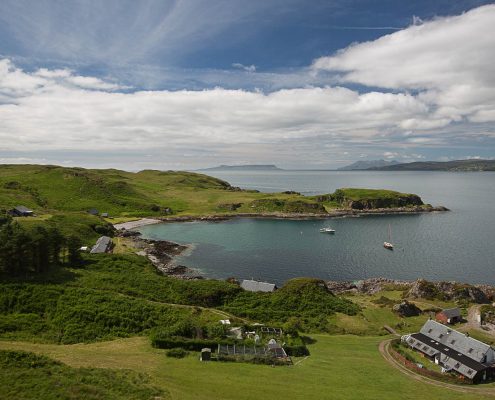
Doune Bay, Knoydart


SMWOA


Hebridean wildlife guide.

If you are interested in seeing more of the wildlife of this area, have a look at our special interest weeks.


At sea

Whales

Minke Feeding........ Minke.........Humpback whale by David Haynes
There are several whales present around the Hebrides, including Sperm, Killer, Northern Bottlenose and Sei whales. However, the commonest is certainly the Minke whale, which grows to about 10 metres and has a distinct white patch on its flippers. They will often approach a boat closely. They are still being commercially hunted by Norway and Japan. If you have seen a whale and wonder what it was, try this whale identification site.
The summer of 2004 gave us some superb whale watching opportunities including an unusual visit from a Humpback whale.


Dolphins

Common dolphins........Bottlenosed dolphin
The Hebrides has many dolphins, some like the porpoise, which are resident all year round. Some like the Common Dolphin which show themselves in June and again in Oct/Nov, in groups of from twenty to several hundred. Other species which are often seen, are Risso's, Bottlenose, White-sided, and White-beaked dolphins.


Basking Sharks

Basking shark.........Basking shark
The second biggest fish in the world, growing up to 12 metres in length. But don't worry, they feed only on plankton. Sightings tend to vary a lot from year to year, but in the Small Isles, late summer is best. Now protected from fishing in UK waters. For more information, contact the Marine Conservation Society.

Turtles

Leatherback TurtleA very rare sighting, though there are several seen in UK waters each year - the Leatherback Turtle. The only turtle species that can be considered to belong here and not a stray. They live off jellyfish and so are highly prone to choking by plastic bags. For more information, see the Marine Conservation Society website where a record of all sightings is being co-ordinated.


Around the islands

Puffins ..............Gannets ........ ..Razorbills......Great Skua

Puffin....Gannet....Guillemots ...Bonxie
There isn't anywhere better in the country for seeing marine birds. From the huge Gannet cities of St Kilda, to the busy puffins of Canna, Mingulay and the Shiants. From the tiny Storm Petrel to the mighty White tailed Sea Eagle. Or the unforgettable experience of a night with the Shearwaters of Rum.


On the shoreline

Otters

Otter- are seen at Doune and around the islands, close to the shore and more rarely inland (even up to the tops of the hills). Best time to see them is around low water, when they find the hunting easiest. Although common, there is concern about their continued success, with the gradual increase of mink all over the Hebrides. Otters are very territorial, especially the females and usually live for 4 -5 years. They often rear 1 or 2 pups which can be born at almost anytime of year. If you would like to learn more about otters or help in their protection worldwide, please visit the International Otter Survival Fund, based on Skye.


Seals

Common seal - both Common and Grey Seals are seen regularly in the area, there being several large colonies in the Small Isles. In 1999 there was a rare visit to Loch Scavaig, by a Bearded Seal down from the Arctic. Grey seal pups are born on remote beaches in Oct/Nov, are white and cannot swim immediately. Unlike Common seal pups which are born mostly in late spring, are dark in colour and can swim as soon as they are born.


On the hill

Red Deer

Red Deer- often seen on the hills of Knoydart, but difficult to get near to (except the ones that come down to the houses at Doune each evening). These days, seen as a bit of a 'baddie' with respect to the regeneration of native woodlands, but very much an important part of the way of life in the Highlands. Calves are born in May (leave young calves well alone if you come across one). Stag culling is in Sept/Oct and you may be asked to help local estates by using certain routes to the hills. The Isle of Rum is actively involved in deer research.


Golden Eagle

Golden EagleA must see for many visitors to this area. There are several pairs in and around Knoydart and the Small Islands. Usual sightings are high up in the hills. It is rare for them to be seen low down and never perched in a tree.